
Molecular Plant Sciences
Programme Profile: Molecular Plant Sciences
The Master’s programme “Molecular Plant Sciences” benefits from a broad spectrum of plant science research areas represented at the Faculty of Biology at JMU by scientists with strong international reputations. Current research topics are directly integrated into the curriculum, ensuring a practice-oriented study programme that fosters independent research work and is supported by close one-to-one supervision.
All available topics share a clear molecular and quantitative causal-analytical focus, combined with the aim of providing both a strong theoretical foundation and hands-on training. The programme is designed to prepare students optimally for future careers in academia, research, teaching, as well as applied fields within the life sciences.
The wide range of plant science topics covered in the programme, offering diverse perspectives and methodological approaches, includes:
-
Plant Membrane Biology
-
Structural Biology
-
Plant Adaptations to a Changing World
-
Plant Biotic Interactions
-
Plant Chemical Biology and Metabolism
-
Plant Signalling Networks
This diversity enables students to tailor their studies according to their individual interests.
The research topics address key factors, including molecular and metabolic aspects, influencing plant growth, development and yield. Of particular interest are plant interactions with abiotic and biotic environmental components, including drought, salt, or heat stress, as well as plant-microbe associations (bacteria and fungi) and plant-herbivore-interactions. The studies investigate the molecular and metabolic strategies underlying plant adaptation to certain current and projected environmental conditions. By analyzing the key components of the associated signaling cascades - from single molecules and single cells to their impact on whole-plant performance - the programme elucidates at various levels and from different perspectives, how plants cope with global challenges.
Programme Schedule
-
S1 TOPIC 1 (2 theory modules plus practical course F1)
-
S2 TOPIC 2 (2 theory modules plus practical course F1)
-
S3 Advanced experimental training (F2, 15CP) + additional special courses (15 CP)
-
S4 Thesis + final colloquium
Each of the two selected topics comprises two theory modules and one practical course unit (F1). Research training is further deepened in the chosen field of major interest within one of the two selected topics during the second practical course (F2) and the thesis. Through these practical training components, students are actively involved in ongoing research projects, where they learn to independently plan and carry out both theoretical and experimental work. Finally, they summarize and discuss the results obtained in their thesis and present them in a final colloquium.
Curriculum
Detailed information on the following modules listed are available in WueStudy under the Online Course Book for the Master‘s Programme in Biosciences, Subtopics 1 and 2, Programme: Molecular Plant Sciences
Year 1 (Winter-Semester)
-
Current Methods in Biology (Lecture)
-
Biophysics and Biochemistry (Lecture/Seminar)
-
Practical Course F1 in one of six topics (see below)
-
Additional Courses WS
Year 1 (Summer-Semester)
-
Plant Immunobiology and Pharmaceutical Biology (Lecture)
-
Plant Adaptations (Lecture/Seminar)
-
Practical Course F1 in one of six topics (see below)
-
Additional Courses SS
Year 2 (Winter-Semester and Summer-Semester, WS + SS)
-
Additional Courses WS or Additional Courses SS
-
Practical Course F2 in one of the two selected topics, followed by the Master’s thesis in the same topic
-
Thesis Colloquium
The practical courses F1, F2 as well as the thesis can be undertaken within the following topics:
-
Plant Signalling Networks
-
Plant Chemical Biology and Metabolism
-
Plant Biotic Interactions
-
Plant Adaptations to a Changing World
-
Plant Membrane Biology
-
Structural Biology
STUDY PROGRAMME
Modules - Theory
Current Methods in Biology (Lecture)
This module covers fundamental and current methods in molecular biology, analytical chemistry and ecophysiology, as well as their applications.
Keywords: qPCR, genomics, transcriptomics, metabolomics, genetically encoded biosensors, next-generation sequencing, gene editing, CRISPR-Cas, RNA interference, chromatography (DC, HPLC, UPLC), mass spectrometry (MALDI, APCI, ESI), vegetation science, water balance.
Biophysics and Biochemistry (Lecture/Seminar)
Theoretical and methodical aspects of membrane transport systems as well as structural biology and biochemistry are discussed, based on current research topics. The lecture series is organized into four major methodical topics: (a) biophysical approaches to investigate membrane transport processes, (b) biochemical methods with a focus on protein crystallization for structure/function research; (c) light microscopy, ranging from basic applications to high-resolution methods; and (d) optogenetic tools for controlling physiological processes using light. The lectures are complemented by demonstration experiments or excursions to state of the art laboratories (dependent on the number of students and the students’ interests). In the seminar each student will present a scientific publication (20 min. talk). All students are expected to actively participate in the associated discussions.
Plant Immunobiology and Pharmaceutical Biology (Lecture)
This lecture addresses topics of pathogen recognition and signal transduction in plants, molecular and organismic defense and the pharmaceutical relevance of plant-derived bioactive compounds.
Plant immunobiology: interactions between plants and pathogens comprise evolutionary dynamic and complex systems. Different strategies of the pathogens – bacteria, fungi and viruses- as well as defense mechanisms of the host plants will be discussed. The molecular mechanisms of pathogen recognition, signal transduction, regulation of gene expression and activation of local and systemic defense responses are in the focus of this lecture. Differences and similarities between plant and human immune systems will be pointed out. Understanding plant-pathogen-interactions and molecular mechanisms determining susceptibility and defense are fundamental to develop strategies in plant protection.
Evolution, function and pharmaceutical relevance of plant specialized metabolites: specialized metabolites are part of effective plant defense strategies against microorganisms and herbivores and are often essential for survival. The evolution of specialized metabolism will be discussed, together with general and specific defense strategies. Pharmacological mechanisms of action and molecular targets of important classes of plant bioactive compounds will be presented. A high proportion of currently used drugs has been developed from plant specialized metabolites that have been used as lead structures to generate potent drugs with improved pharmaceutical properties. Examples of therapies with very potent plant pharmaceuticals as well as possibilities and limitations of phytotherapy will be discussed.
Plant Adaptations (Lecture/Seminar)
The module encompasses four sections with different foci. Students actively take part in all four sections.
- Kick-off meeting and Intro: In this meeting the seminar topics (see section IV), the dates for two excursions (see section III), and the exam will be scheduled. In the following two lectures, we will introduce general concepts of plant ecology.
-
The second section introduces molecular aspects of plant ecology. For example, we outline the
◦ genetic basis of natural variation,
◦ physico-chemical basis of plant surface interactions with the environment,
◦ physiological aspects of plant interactions with fungi and bacteria,
◦ molecular regulation of plant root endosymbiosis,
◦ genetic and physiological basis of nitrogen acquisition. - The third section comprises lectures about the relationships between climate, soil, and vegetation. In addition, two excursions will introduce selected plant communities in the field.
- In the fourth section, each student will present a scientific publication in a literature seminar (20 min. talk). All students are expected to actively participate in the associated discussions.
Modules – Practical Courses F1/F2
Biophysics of Plant Membrane Proteins F1
The module provides an in-depth insight into modern biophysical methods and strategies employed to study membrane proteins and molecular signaling pathways in plants. Students will learn how to use advanced techniques in life sciences and contribute to ongoing research projects addressing contemporary topics in “Plant Membrane Proteins”.
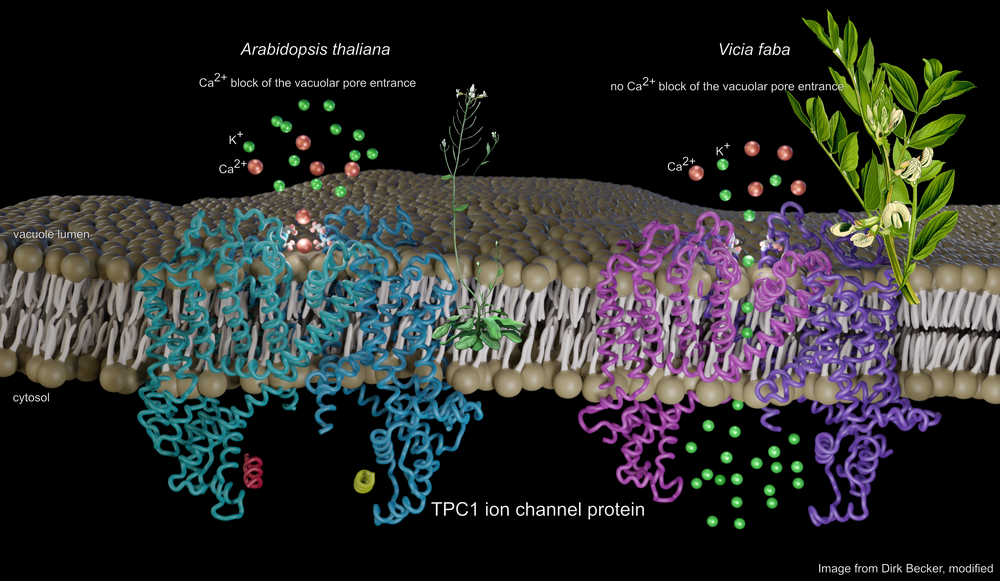
The research focuses on globally important challenges, such as maintaining crop production on salinized soils or under prolonged drought. We aim to understand how membrane transport proteins enable plants to cope with drought or salt stress, and how they transport sugars, amino acids, phytohormones and secondary metabolites from source (photosynthetic) tissues to sink (storage) tissues in crop plants. Depending on the research topic, students will learn electrophysiological techniques (e.g., Patch-Clamp, Two-Electrode Voltage-Clamp, impalement electrode technique, voltage-clamp fluorometry), often combined with fluorescence microscopy (e.g., Ca²⁺-imaging using bright-field, spinning-disk, and confocal laser scanning microscopy, optogenetic tools, FRET, FLIM) and techniques to visualize interactions between proteins (Splitt-Luciferase, Splitt-YFP or FRET-based techniques). Additional methods include gene expression in heterologous systems (Xenopus laevis, HEK cells) and molecular biological techniques (cloning strategies, PCR, in vitro RNA synthesis, RNA/DNA extraction, gel electrophoresis, reporter gene-fused transporter constructs, site-directed mutagenesis).
Plant Signalling F1
Plants need to adapt to changing environmental conditions. Molecular mechanisms and components of plant signal transduction and regulation of gene expression will be investigated in the context of plant responses to abiotic stress, plant-pathogen interaction, lipid signalling and plant hormone signalling. Students will quantitively work on ongoing research projects and apply specific molecular biological, plant physiological, biophysical and/or analytical methods as well as fluorescence or luminescence-based techniques to address these topics.
Plant Chemical Biology and Metabolism F1
All organisms are able to reprogram their metabolism in response to various endogenous or exogenous perturbations. Reprogramming of metabolism is often correlated to phenotypic changes e.g. in disease development or physiology In this module metabolomics is applied for gene function- or stress response analysis. Students can choose a topic from the diverse running projects. Depending on the scientific question of the research group, the methodological approach employs methods from metabolite analysis/bioanalytics and/or molecular biology. In this module, students will be trained to use quantitative metabolite analysis methods (chromatography, mass spectrometry) and apply advanced molecular biology techniques. Depending on the project, different model organisms are studied. Prior knowledge in metabolite analysis or mass spectrometry is not required.
Molecular Plant Physiology F1
This module provides in-depth insight into molecular strategies and methods employed in modern plant physiology. Students will learn how to use advanced techniques in life sciences and contribute to ongoing research projects addressing up-to-date topics in “Molecular Plant Physiology”.
Physiological Plant Ecology F1
Under the guidance of an experienced scientist, the student work on a current research topic from the field of ecology/ecophysiology. Special topics are the physiological bases of the interactions between plants and abiotic and biotic environmental factors (e.g. water relations, stress, biogeography). Working concepts and complex experiments are designed, and the results will be documented and presented as presentations, publications or protocols. The participants are involved in ongoing projects and deepen their knowledge on applying special methods, especially in ecophysiology, but also in chemical analysis.
Molecular Plant-Microbe-Interactions F1
In the context of current research, a project alternatively with focus on the molecular regulation and communication mechanisms in bacteria or fungi/plant-interactions or on the genetic control of nitrogen foraging will be carried out. Working concepts will be designed and complex experiments will be performed. The experimental results will be presented and critically discussed by a presentation and a protocol. Students learn and deepen their knowledge on applying special methods in molecular biology, microscopy and ecophysiology.
Biochemistry and Structural Biology F1
The module focuses on the principles and modern approaches in Protein Biochemistry and Structural Biology. The students will perform their studies integrated into research projects of current topics in “Biochemistry and Structural Biology”. Depending on the research project students will learn how to analyze structure-function relationships of biomolecules and integrate this knowledge in protein design/engineering. They will receive training on designing strategies for preparative recombinant protein expression and purification for experimental structure analysis. The results would be presented and discussed through a presentation and a protocol.
Practical courses F2
Following completion the F1 practical courses, students are required to undertake an F2 practical course as a pre-master’s thesis internship in one of the two selected topics. The F2 course and the master thesis are usually carried out on the same topic. During the practical course F2 the students perform their research work within an ongoing research project on the chosen topic in a largely independent manner under the supervision of a principle investigator. The students are qualified to address scientific issues by using appropriate methods. They are capable to independently design the appropriate experiments and to analyze, document, present and discuss the results. They are qualified to conduct scientific work, perform statistical analysis and interpretation. The acquired knowledge qualifies the students to perform scientific activities.
ADDITIONAL COURSES
Additional Courses (5 ECTS unless indicated)
Biochemistry, Physiology and Genetics of Mammalian Cell Culture
Introduction to cell culture, cell culture lab equipment, cellular biochemistry and cell structures, cell proliferation, generation of in vitro cell models and their applications, cell culture formats, basic cell analytical technologies.
Molecular Techniques
Introduction to new and cuttingedge molecular techniques. As well as methods for scientific investigation.
Molecular Tumour Biology
The lecture „Molecular Tumor Biology“ discusses molecular characteristics of tumors and relevant biological processes (such as signal transduction, cell growth, cell proliferation, metabolism), tumor specific modifications and current molecular biological methods in tumor research.
Clinical Tumor Biology
In the lecture series „Clinical Tumor Biology“ current clinical aspects will be discussed. Several tumor types will be considered (such as tumors of the skin, lung, intestine, breast, blood). Diagnostics & pathology, different treatments and therapies and clinical trials will be further topics.
Animal Communication
The lectures deal with physiological and neurobiological principles of the different communication channels used by animals, but also highlight adaptive values and evolutionary aspects of animal signaling. In a follow-up seminar session students will deepen their knowledge by presenting and discussing actual papers related to the topic of the lecture.
Experimental Sociobiology
The lectures highlight the diversity and the evolution of social behavior, but also focus on the physiological, neurobiological and behavioural mechanisms underlying the organization of social groups. In a follow-up seminar session students will deepen their knowledge by presenting and discussing actual papers related to the topic of the lecture.
Immunology 1 B
Basic concepts of modern cellular and molecular Immunology.
Immunology 2 B
Current topics in molecular and cellular immunology with emphasis on autoimmunity. allergy, immunomodulation, cancer and transplantation immunology, immunity of infection and evolution of the immune system.
Virology 1 B
This course offers an introduction to virology and current research in the field of virology.
Virology 2 B
This course offers an introduction to virology and current research in the field of virology.
Nucleus Workshop
A combination of lecture and laboratory course. Topics include the nuclear envelope, nuclear pores, nuclear-cytoplasmic transport, nuclear lamina, chromatin, chromosomes and disease, structure and function of the nucleolus, communication between the cytoskeleton and the nucleus. Experiments include
-
Electron microscopy of the nuclear envelope, pores and lamina;
-
Growth of the nuclear envelope: Experiments using cultured cells and Drosophila
-
Preparation of a Xenopus-egg extract and in vitro-assembly of artificial nuclei
-
In-vitro assembly of lamina-filaments
-
Isolation of nuclear envelope from cultured cells; Protein analyses using Western blotting.
-
Visualization of nucleosomal chromatin in EM (Miller-Speading).
-
Extraction of histones und analyses via one- and two-dimensional gelelectrophoresis.
-
Visualization of transcriptional active genes.
-
Structure and function of the nucleolus; influence of cellular toxins.
-
Isolation of ribosomes and ribosomal subunits using a sugar gradient centrifugation and protein analyses
-
Nucleolar behavior during mitosis (Immunofluorescence microscopy using a nucleolus specific antibody).
-
The nucleolar organizer region (NOR), Silver staining and immunolocalization
-
Localization of transcription sites in the cell nucleus (BrU incorporation).
- Protein-Protein interaction in the cell nucleus (in situ proximity ligation assay).
- Chromatin immunoprecipitation (Chip)
Additional Courses & Final Thesis
Ecology of Honey Bees and Wild Bees
This practical course introduces students to the life of honey bees and wild bees; principles and techniques of beekeeping (colony management, breeding, diseases); resource use of honey bees and wild bees (bee dances, flower visiting, pollen analysis, foraging behavior, nesting aid); Taxonomy of wild bees, opponent of bees, wild bees in different habitats (excursion), honey bee excursion, e.g. visiting of the bee center in Veitshöchheim.
Forest Ecology
Winter semester: This practical course will be held as a block-course at the Jungendwaldheim, Wessely Haus, Bavarian Forest National Park. Contents include the determination and detection of mammals and birds in mixed mountainous forests. Also, we will conduct experimental fieldwork and related data analysis methods.
Summer semester: This practical course will be held as a block-course at the Field Station Fabrikschleichach. Contents include the determination and detection of Arthropods in forests dominated by beeches in the Steigerwald. Focus are conservation relevant species and species relevant for phytosanitary control measures. Also, we will conduct experimental field- and laboratory work.
Global Change Ecology
This practical course provides students with an overview of the impacts of global change on biological systems. Using literature, media and data analyses as well as field trips and modelling, the significance of various anthropogenic influences (e.g. climate and land use change, pollution, invasive species) on species and ecosystems is examined. In interactive and interdisciplinary formats (e.g. expert discussions, role plays), the students will deepen what has been learned and options for action will be developed and discussed.
Macroecology
This practical course provides students with an introduction to macroecology (which deals with patterns and processes of biological diversity at large spatial and temporal scales) and, in particular, practical knowledge and skills of macroecological research. Using prepared (bio)geographic and ecological data, students will analyse large-scale biodiversity patterns, the influence of abiotic factors on species distributions and species richness, and potential conservation applications. In individual projects students will apply the learned methodological approaches.
Endogenous clocks B
This theory module gives an introduction into endogenous clocks of unicellular organisms, fungi, plants and animals, with focus on the neuronal organisation of the clock in the brain of mammals and insects. The biological functions of endogenous clocks and the underlying mechanisms will be discussed on the molecular, cellular and organismic level. How clocks adjust to a 24 h day with variable photoperiods will be explained. Applied aspects regarding e.g. shift work or jetlag will also be included.
Programming using Python
In times of constantly growing amounts of data, basic programming skills should be among the essential skills of a natural scientist. The Python programming language provides a smooth introduction to the subject and is therefore also gaining popularity among users outside of traditionally computer-based disciplines.
Presentation of Scientific Data
The students write a scientific mini review including correct citation and learn various options to present scientific data including manuscript writing followed by an oral presentation (15 min).The manuscript is based on original papers as well as on reviews and follows the instructions of a scientific journal of choice, which may be found at the home page under e.g. “Instructions to Authors”. Both length of chapters and structure of the article should be based on the style of the selected journal. Attendance at 20 or more scientific talks (e.g. defense of doctoral thesis, presentation of research projects, retreats) including presentation by guest speakers.
Quality Assurance, Good Practice, Biosafety and Biosecurity
Good Practice in the Biosciences, quality assurance approaches and quality culture. Structure, idea and basic principles of quality management approaches, DIN EN ISO 9001, regulatory documents and framework in the biosciences including biotechnology, biosafety, biosecurity, risk assessment.
FINAL THESIS
Thesis (25)
C: A defined scientific question is addressed by adequate techniques. Students plan and perform experiments to solve problems or summarize and interpret existing data. The students have to develop a research plan and apply advanced and novel techniques in the context of a given research project according to good scientific practice. The results are summarized in a written thesis. The project lasts for six months.
LO: Students are qualified to scientifically work on a topic on their own. They are competent to discuss the current research in the field. They are competent to work according to good practice and to document, interpret and to discuss their results. They are competent to discuss and to defend their data in the scientific community.
Thesis Defense / Oral examination Biology (3)
C: Verification of thesis content through oral examination. Total length should not exceed 45 min. (30 min. plus 15 min. of questions pertaining to the thesis, as well as related subjects)
LO: The students are able to present the results of their thesis work to a public audience in a limited time and they are able to critically discuss questions and concerns.
Contact
Prof. Dr. Ulrich Hammes

Prof. Dr. Nathalie Lackus