
Nobel Prize: How plant research benefits from optogenetics
10/13/2026The work of Nobel Laureate Georg Nagel benefits not only medicine but also plant research. His long-standing colleagues in Würzburg – Dietmar Geiger, Kai Konrad and Dirk Becker – explain why.
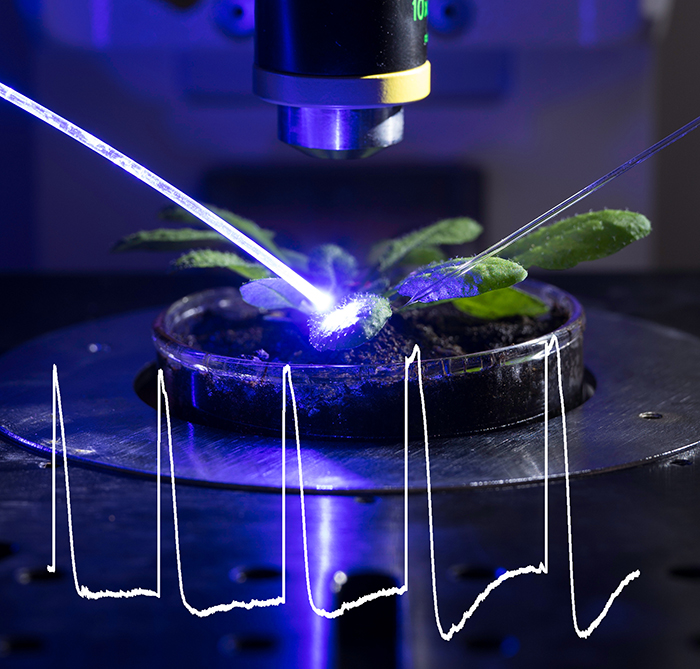
The 2026 Nobel Prize in Medicine has been awarded to Georg Nagel (University of Würzburg, Figure 1) and his colleagues Karl Deisseroth ( Stanford University) and Peter Hegemann ( Humboldt University of Berlin). The prize recognises their discoveries of light-controlled ion channel proteins and the resulting development of optogenetics (JMU press release of 5 October 2026).
Whilst he was head of a research group at the Max Planck Institute for Biophysics in Frankfurt am Main, Georg Nagel, together with Peter Hegemann, discovered and described ion channels from the single-celled green alga Chlamydomonas reinhardtii, which proved to be cation channels directly controlled by blue light. The channels consist of a light sensor (rhodopsin) and an ion channel, are located in the cell membrane and were named channelrhodopsins. These proteins have since been the focus of Georg Nagel’s research.
Biophysics as the key to understanding light-controlled channels
With the help of biophysics, Georg Nagel bridged the gap between the complexity of life and the simplicity and universality of the laws of physics. In this way, he made a significant contribution to our understanding of the transport cycle and the control mechanism of light-controlled transport proteins.
To this end, he introduced the ion channels from the algae into the cell membranes of egg cells from the South African clawed frog and, for the first time, described their biophysical properties using electrophysiological techniques. Nagel was able to demonstrate that the green algal channelrhodopsins react very sensitively to blue light stimuli and switch very rapidly. Furthermore, they proved to be primarily permeable to protons and less permeable to cations such as sodium, potassium or calcium, which play a role in establishing membrane potential, in osmoregulation or as signalling molecules.
Georg Nagel and his colleagues quickly recognised the potential applications of channelrhodopsins. Thus, they became the founding fathers of a new field of research – optogenetics. The appeal of this technique lies in the non-contact control of electrical stimuli, which can be applied with pinpoint accuracy and at variable frequencies and amplitudes.
Establishment and optimisation for use in optogenetics
Following his appointment as Professor of Molecular Plant Physiology at the Chair of Botany I at the Julius-von-Sachs Institute at the Biozentrum of the University of Würzburg in 2004, Professor Nagel focused on optimising the light-controlled channels for use as optogenetic tools.
Through targeted mutations, he and his colleagues were able to identify regulatory elements within the channelrhodopsins to enhance their expression in animal and plant cells, as well as to increase the duration for which the channel pore remains open and the selectivity for individual cations. His meticulous work and perseverance also expanded the repertoire of light-controlled ion channels.
Using these optimised optogenetic tools, electrical stimuli can now be triggered or inhibited by light in a wide variety of nerve cells. Thanks to the work of the three Nobel Laureates, these optogenetic methods are now used in laboratories around the world to investigate neural functions related to memory, emotions and behaviour, as well as to research neurological disorders.
Molecular plant research benefits from optogenetic tools
Although the first channelrhodopsins originated from simple green algae, searches for them in the genomes of flowering plants have so far proved fruitless. Although plants do not possess nerve cells or a central nervous system, they communicate using electrical signals, both between individual cells and between tissues located at a distance from one another.
In this way, plants transmit information – such as details of injuries caused by predators or a localised pathogen infestation – to more distant parts of their bodies. It is believed that the plant’s conducting tissues play a crucial role in this long-distance transport of information. However, research into such signalling pathways is still largely in its infancy.
The light-controlled ion channels developed by Georg Nagel are playing an increasingly important role here as optogenetic tools. In plants, too, these light-controlled channels can be used to trigger precise electrical signals, enabling the physiological consequences of electrical stimulation to be studied without physical contact.
But how can a plant distinguish between different stimuli, such as mechanical wounding and infection by pathogens? Here, the ability to modulate the frequency and amplitude of these electrical signals—artificially triggered by light—is of inestimable value: on the one hand, this allows the threshold potential to be determined; on the other, it enables the specificity of the plant’s physiological responses to different signal patterns to be investigated.
Calcium signals at the touch of a button
At the Julius von Sachs Institute in Würzburg, Georg Nagel has optimised his optogenetic tools in many respects and for a variety of research questions. For example, he has increased the permeability of channelrhodopsin-2 to calcium ions to such an extent that this optogenetic tool functions as a light-controlled calcium ion channel.
This property is of outstanding interest to plant research, as calcium acts as a secondary messenger and many stress responses in plant cells are mediated by increases in calcium levels. Plant cells can ‘read’ calcium signals and translate them into a stress-specific physiological response. Using the calcium-permeable channelrhodopsin, the frequency and intensity of the calcium signal can be modulated, and the effects of these changes can be investigated non-invasively.
Researchers at the Chair of Molecular Plant Physiology and Biophysics, Botany I, at the Julius von Sachs Institute, are convinced that both the contactless and precisely targeted delivery of electrical signals and the triggering of defined calcium signals are key to a deeper understanding of complex molecular signalling processes in plants.
Initial studies and publications attest to the pioneering potential of the optogenetic switches developed by Nobel Laureate Georg Nagel. The Julius von Sachs Institute of Biological Sciences extends its warmest congratulations to him on his outstanding success and takes great pride in his achievements.
Contact
Dietmar Geiger
Julius-von-Sachs-Institut für Biowissenschaften
Molekulare Pflanzenphysiologie und Biophysik (Botanik I)
Julius-von-Sachs Platz 2, 97082 Würzburg
E-Mail: dietmar.geiger@uni-wuerzburg.de