

Würzburg to become a hub for the international proteomics community
06/23/2026Around 500 protein researchers are expected in Würzburg in late 2026. The Proteomics Forum 2026 will be held here alongside the 15th EuPA Congress. Conference abstracts may be submitted until 30 June; the registration deadline is 15 September.
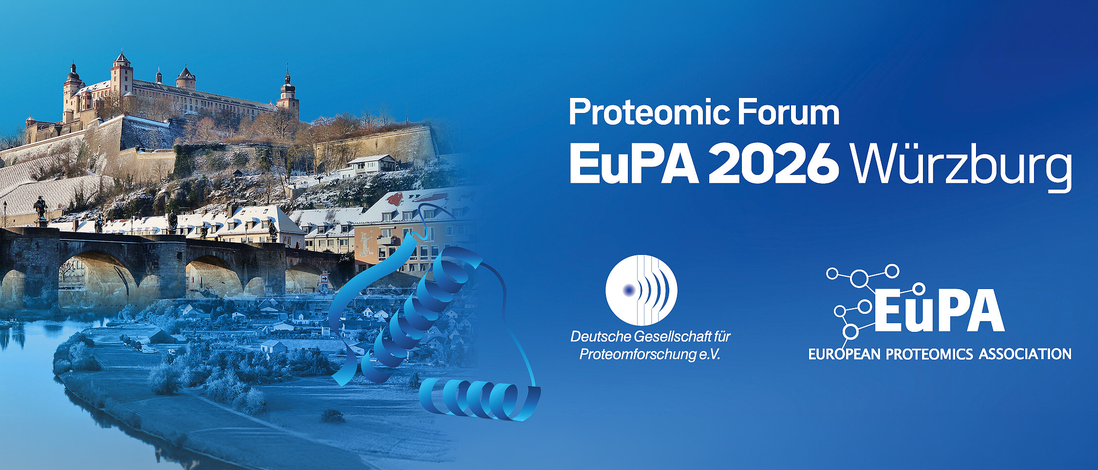
From 29 November to 3 December 2026, the Congress Centrum Würzburg will become the focal point of the international proteomics community: the German Society for Proteomics (DGPF) is organising the Proteomics Forum here – this year in conjunction with the 15th Annual Congress of the European Proteomics Association (EuPA). As the largest congress in its field for 2026, the event is expected to bring together around 500 researchers from 18 countries.
“Hosting both events brings the international proteomics community together at the highest scientific level and facilitates a professional exchange on a scale that is rarely experienced otherwise” says Professor Bettina Warscheid, First Vice-President of the DGPF and Chair of Biochemistry II at the University of Würzburg.
Proteomics could enable earlier detection of diseases
Proteomics studies the totality of all proteins in a cell – and thus the molecular basis of health and disease. New methods now make it possible to analyse thousands of proteins simultaneously and to track dynamic changes with precision. An example: In research, proteomic methods are currently being used with the aim of detecting Alzheimer’s disease or cancer at a much earlier stage – for instance, through characteristic protein patterns in the blood – as well as uncovering the molecular mechanisms underlying the development of diseases. Such approaches could, in future, enable diagnoses to be made long before the first symptoms appear.
The conference will feature eight plenary lectures and seventeen thematic symposia. It will thus provide a comprehensive overview ranging from the latest methodological innovations to the translational applications of proteomics. Professor Martin Eilers, Chair of Biochemistry and Molecular Biology at the University of Würzburg, will commence the event with an opening lecture on the role of the oncoprotein MYC in cancer development.
Topics of the scientific programme
The wide-ranging scientific programme focuses on new developments in functional and clinical proteomics, multi-omics research and systems biology, immunoproteomics, single-cell and structural proteomics, and environmental proteomics.
These topics are complemented by new approaches in mass spectrometry and computer-aided data analysis, as well as the use of artificial intelligence to analyse complex biological datasets.
In addition, participants will discuss advances in glyco- and top-down proteomics, alongside innovative strategies for standardising clinical blood proteome analyses. The conference thus covers a broad spectrum, ranging from technological innovations and fundamental biological questions to clinical applications in precision medicine.
Registration: Researchers and students wishing to attend must register by 15 September 2026.
An early-bird rate is available until 15 July 2026.
Abstracts: Conference papers may be submitted until 30 June 2026.
Conference website: https://proteomic-forum.com/
Spotlight on Würzburg as a research hub
By hosting the conference, Julius-Maximilians-Universität Würzburg (JMU) is demonstrating its strong commitment to biomedical research. Researchers from biochemistry, molecular and cell biology, systems biology, medicine and data science are driving key developments in proteomics at JMU – ranging from innovative mass spectrometry technologies and data-driven analysis methods to new applications in basic and clinical research.
About the organisers
The German Society for Proteomics (DGPF) brings together around 300 experts from academia and industry. It promotes proteomics in Germany through coordinated initiatives.
The European Proteomics Association (EuPA), as an umbrella organisation, brings together 23 national professional societies. It strengthens collaboration in research, training and the application of proteomics in Europe.
Contact
Prof. Dr Bettina Warscheid, Chair of Biochemistry II, University of Würzburg, bettina.warscheid@uni-wuerzburg.de